
Test_02
Find out how release force, liner surface chemistry, and adhesive compatibility impact performance and efficiency in silicone PSA applications.

Last updated:
1. Why Release Liner Selection Matters—Starting from Coating
In silicone PSA systems, the release liner is more than just a carrier—it plays a functional role in the adhesive system. For coating companies, liner selection affects:
- Coating uniformity and flow behavior
- Adhesive wetting and curing
- Release force stability after thermal exposure
- Yield rate across slitting, lamination, and storage
- Consistent release during lamination and automated peeling
- Clean die-cut edges without liner breakage or deformation
- Stable adhesion to skin, films, or devices after liner removal
2. Key Factor #1: Release Force—Not Too High, Not Too Low
Release force is the measurable energy needed to peel the liner from the adhesive. It directly impacts:
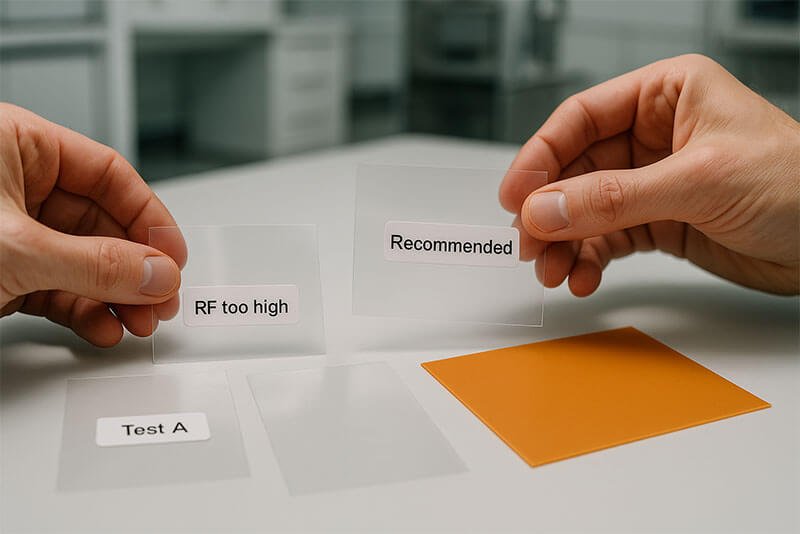
- Coating line performance: High peel force can distort wet films
- Roll separation and unwind: Too low can cause premature liner separation
- Lamination accuracy: Inconsistent force disrupts web tension
- End-user peel-off experience
Recommended Ranges (indicative only):
| Application | Suggested Release Force |
|---|---|
| Inline PSA coating | 10–30 g/in |
| Die-cut tapes | 20–50 g/in |
| Medical patches | 30–60 g/in |
| Protective films | 60–100 g/in |
Tip: Don’t rely on nominal values alone. Test release force before and after oven exposure, as some liners (especially standard silicone) shift under heat or humidity.
3. Key Factor #2: Surface Chemistry & Coating Compatibility
- The liner has residual siloxanes that interact with the PSA
- There’s a chemical similarity between liner and adhesive → partial anchoring
- The release coating is too smooth or too hydrophobic → poor wetting
Fluorosilicone-Coated Liners: The Preferred Choice
Fluorosilicone coatings provide:- Clear separation from silicone PSAs
- Low interaction risk with curing agents
- Stable release force even under accelerated aging
- Compatibility with peroxide and platinum systems
- PET: Excellent dimensional control
- Glassine: Good cost–performance for limited-use products
- BOPP: For flexible or roll-form applications
4. Key Factor #3: Silicone PSA Release Liner and Adhesive Compatibility
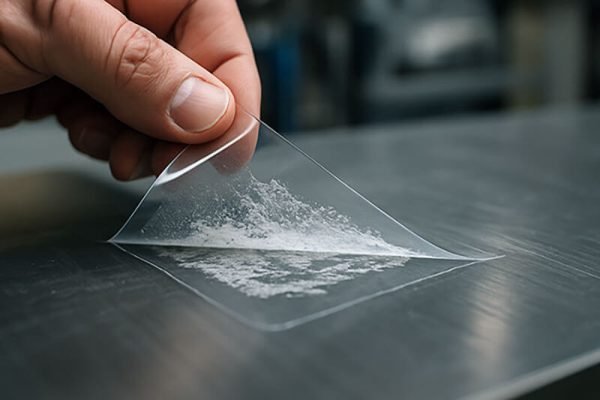
▸Even with a high-grade liner, mismatch with your PSA formula causes:
- Poor wetting → voids, fish-eye defects
- Adhesive transfer during liner removal
- Surface residue affecting bonding or skin contact
- Variability in tack or dwell time performance
▸Different PSA chemistries require different liner strategies:
- Silicone PSA → Fluorosilicone liner
- Acrylic PSA → Standard silicone liner or low-release silicone
- Hydrocolloid / gel adhesives → Custom-coated PET or PE liners
▸Run compatibility tests at both coating and converting stages, including:
- Initial and aged release force
- Curing uniformity (if heat cured)
- Surface analysis (e.g., FTIR, contact angle, transfer observation)
5. Converting Tips—Where Liner Design Becomes a Productivity Tool
▸Once coated, the liner has to survive and perform during:
- Slitting
- Die-cutting
- Lamination to backings or substrates
- Automatic dispensing
▸Key liner parameters for converters:
- Caliper tolerance: Prevents slitter misalignment
- Stiffness: Required for high-speed lamination
- Anti-static treatment: Avoids particle attraction
- Slip control: Reduces curl and improves roll handling
6. Conclusion: The Right Liner Protects Every Step—From Coating to Application
For silicone PSA products, the liner isn’t a commodity—it’s part of the product system. Selecting the wrong liner causes visible and invisible losses:
- Yield loss during coating
- Cure failure and customer returns
- Converting inefficiencies and scrap
- Adhesion failure in the field
- Release force at different temperatures
- Surface energy match
- Thermal aging behavior
- Dimensional control and curling resistance