
Fluorosilicone Release Liners for Automotive and EV Components
Our fluorosilicone release liners support advanced bonding and protection needs across the automotive and EV industry. Engineered for high-tack silicone adhesives, they enable clean release, thermal stability, and high-speed die-cutting performance—critical for EV battery insulation, EMI/RFI shielding, and silicone gasketing.
Applications such as silicone-based OCA bonding in displays are detailed in our Functional Coated Materials.
Key Benefits
Clean Release for Silicone PSA Applications
Fluorosilicone liners provide ultra-low release force for high-tack silicone adhesives used in EV battery pads, EMI shielding, and gasket constructions.
Stable Performance Under Heat and Pressure
PET-based liners withstand elevated temperatures, web tension, and lamination pressure without curling or adhesive distortion.
Compatible with High-Speed Converting Processes
Designed for slitting, die-cutting, and kiss-cutting at industrial speeds. Ensures dimensional stability during converting and precise release control.
Prevents Silicone Migration or Adhesive Contamination
Fluorosilicone coatings form a contamination-resistant barrier—critical for multilayer constructions, insulation films, and adhesive die-cuts.
Custom Release Levels and Substrate Options
Available in multiple release force levels and PET thicknesses to match adhesive tack and converting method.
Applications

EV Thermal Interface Pads
EMI / RFI Shielding Tapes
Silicone Gaskets
Sensor Films & Display Laminates
Customized Fluorosilicone Release Liners for Automotive & EV Applications
Engineered for EV battery insulation, EMI/RFI shielding, vibration-damping gaskets, and multi-layer sensor films, our fluorosilicone liners provide stable release performance under heat, pressure, and high-speed die-cutting environments.
Fluorosilicone Release Liner Models for Automotive & EV Components
Representative configurations tailored for EV battery insulation pads, EMI shielding tapes, vibration damping gaskets, and laminated sensor films.
Model | Release Force | Substrate | Key Features |
|---|---|---|---|
Ultra Low (<3 g/in) | PET 50µm | Ideal for EV battery insulation pads using silicone-based thermal adhesives. Provides ultra-clean release without adhesive lift or distortion during die-cutting and lamination. | |
Low (3~10 g/in) | PET 50 μm | Suitable for EMI/RFI shielding tapes and conductive foil bonding. Ensures smooth converting and reliable placement in automotive electronics. | |
Moderate (10–30 g/in) | PET 50µm | Recommended for silicone foam gaskets and vibration-damping pads. Offers curl resistance and stable release during kiss-cutting and multi-layer converting. | |
Heavy (>30 g/in) | PET 50µm | Designed for strong-bonding structural tapes or thick silicone adhesives in sensor module assembly. Maintains adhesion under thermal cycling and stress. |

Need a precision release liner for your EV component or automotive application?
Automotive & EV Components-Specific FAQ
No. Our fluorosilicone release liners are engineered to minimize silicone migration and surface contamination, helping preserve adhesive integrity after lamination, heat curing, or high-pressure bonding. This ensures strong and stable adhesion in battery insulation pads, structural tapes, and sensor modules.
Yes. Our liners offer consistent release force and dimensional stability across the web, minimizing issues like adhesive shifting, liner curl, or die misalignment. This helps reduce material waste and increase converting efficiency in roll-to-roll processing.
Absolutely. Our liners are engineered to withstand high-speed kiss-cutting, slitting, and laser die-cutting without tearing or edge curling. This ensures clean separation and tight-tolerance parts for EMI shielding, foam gaskets, and vibration-damping components.
Yes. PET-based fluorosilicone liners deliver excellent thermal resistance and dimensional control, making them ideal for EV battery insulation tapes and heat-cured adhesive systems. They perform reliably under extended thermal cycling and stress.
Yes. We offer optimized release levels to balance strong hold during transport and clean peel during assembly. This makes them compatible with robotic pick-and-place, manual assembly, and inline lamination in automotive tape applications.
Yes. Dual-sided fluorosilicone release liners are available for multilayer tape constructions and differential adhesive systems. These liners support precision laminating and bonding in high-spec automotive sealing or thermal interface applications.
Related Insights
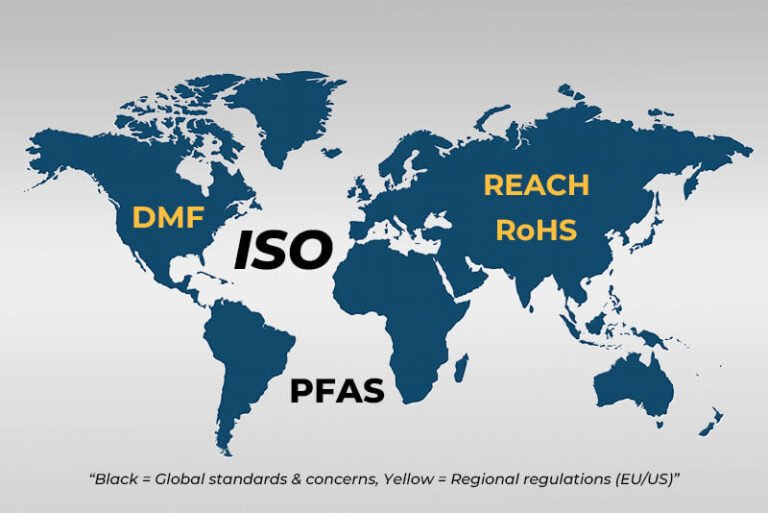
Regulatory Compliance for Fluorosilicone Release Liners – Global Standards and Requirements
Test_04