
Fluorosilicone vs. Silicone Release Liners: When to Choose Each for Reliable Peel Control
Find out how release force, liner surface chemistry, and adhesive compatibility impact performance and efficiency in silicone PSA applications.

Last updated:
1. Why Release Liner Selection Matters—Starting from Coating
In silicone PSA systems, the release liner is more than just a carrier—it plays a functional role in the adhesive system. For coating companies, liner selection affects:
- Coating uniformity and flow behavior
- Adhesive wetting and curing
- Release force stability after thermal exposure
- Yield rate across slitting, lamination, and storage
- Consistent release during lamination and automated peeling
- Clean die-cut edges without liner breakage or deformation
- Stable adhesion to skin, films, or devices after liner removal
2. Key Factor #1: Release Force—Not Too High, Not Too Low
Release force is the measurable energy needed to peel the liner from the adhesive. It directly impacts:
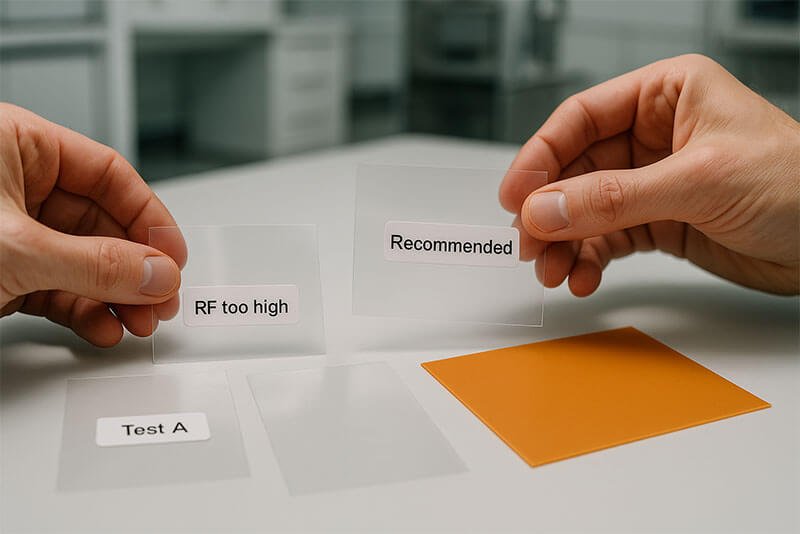
- Coating line performance: High peel force can distort wet films
- Roll separation and unwind: Too low can cause premature liner separation
- Lamination accuracy: Inconsistent force disrupts web tension
- End-user peel-off experience
Recommended Release Level (indicative only):
| Application | Recommended Release Level | Validation Notes |
|---|---|---|
| Inline PSA coating | Ultra Low / Low | Confirm with your actual PSA formulation; verify initial vs. post-oven aging. |
| Die-cut tapes | Low / Medium | Use customer’s tape/adhesive for cross-check when possible. |
| Medical patches | Medium | Validate stability after storage/aging; results can drift over time. |
| Protective films | Medium / Heavy | Heat/humidity can shift release; test after exposure, not only at shipment. |
Tip: Release level is a relative descriptor (not an absolute spec). Test with a defined method (e.g., 180° or 90° peel; 300 mm/min as a common baseline) and compare results before and after oven / 85°C&85%RH exposure. Prioritize validation using the customer’s actual tape/adhesive system where possible.
3. Key Factor #2: Surface Chemistry & Coating Compatibility
- The liner has residual siloxanes that interact with the PSA
- There’s a chemical similarity between liner and adhesive → partial anchoring
- The release coating is too smooth or too hydrophobic → poor wetting
Fluorosilicone-Coated Liners: The Preferred Choice
Fluorosilicone coatings provide:- Clear separation from silicone PSAs
- Low interaction risk with curing agents
- Stable release force even under accelerated aging
- Compatibility with peroxide and platinum systems
- PET: Excellent dimensional control
- Glassine: Good cost–performance for limited-use products
- BOPP: For flexible or roll-form applications
4. Key Factor #3: Silicone PSA Release Liner and Adhesive Compatibility
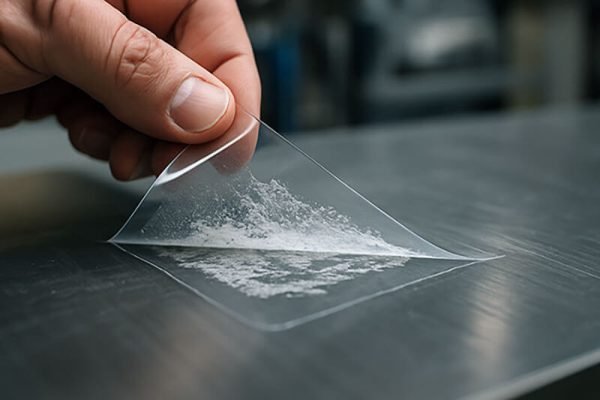
▸Even with a high-grade liner, mismatch with your PSA formula causes:
- Poor wetting → voids, fish-eye defects
- Adhesive transfer during liner removal
- Surface residue affecting bonding or skin contact
- Variability in tack or dwell time performance
▸Different PSA chemistries require different liner strategies:
- Silicone PSA → Fluorosilicone liner
- Acrylic PSA → Standard silicone liner or low-release silicone
- Hydrocolloid / gel adhesives → Custom-coated PET or PE liners
▸Run compatibility tests at both coating and converting stages, including:
- Initial and aged release force
- Curing uniformity (if heat cured)
- Surface analysis (e.g., FTIR, contact angle, transfer observation)
5. Converting Tips—Where Liner Design Becomes a Productivity Tool
▸Once coated, the liner has to survive and perform during:
- Slitting
- Die-cutting
- Lamination to backings or substrates
- Automatic dispensing
▸Key liner parameters for converters:
- Caliper tolerance: Prevents slitter misalignment
- Stiffness: Required for high-speed lamination
- Anti-static treatment: Avoids particle attraction
- Slip control: Reduces curl and improves roll handling
6. Conclusion: The Right Liner Protects Every Step—From Coating to Application
For silicone PSA products, the liner isn’t a commodity—it’s part of the product system. Selecting the wrong liner causes visible and invisible losses:
- Yield loss during coating
- Cure failure and customer returns
- Converting inefficiencies and scrap
- Adhesion failure in the field
- Release force at different temperatures
- Surface energy match
- Thermal aging behavior
- Dimensional control and curling resistance
A well-matched liner makes your coating process smoother, your converting easier, and your product more reliable.
Curious how fluorosilicone liners compare to standard silicone coatings? Read our Compatibility Guide for Silicone PSA Applications
to understand when and why to choose one over the other.