
How to Choose a Compatible Release Liner for Your Adhesive
Why Compatibility Matters for Silicone, Acrylic, and UV-Curable Adhesives
A Small Mismatch. A Big Problem.
A mismatch between a release liner and adhesive doesn’t just reduce efficiency—it risks product failure.
Poor wetting, curing inhibition, adhesive transfer, or surface residue often originate at the liner–adhesive interface. If you see voids, fish-eyes, or erratic peel force during lamination or converting, chances are the problem starts long before final application.
This article explains how liner compatibility affects performance, how to detect mismatch risks, and when to consider alternatives like fluorosilicone liners.
Why Liner–Adhesive Compatibility Matters
The wrong liner can ruin your adhesive before it even reaches your product.
Surface chemistry at the liner–adhesive interface can block curing, cause anchoring, or leave residue—all before lamination begins.
A non-compatible liner can:
- Inhibit curing (especially UV or platinum-catalyzed systems)
- Trigger adhesive anchoring or over-wetting
- Cause transfer or residue on the substrate
- Alter dwell-time sensitivity and final adhesion strength
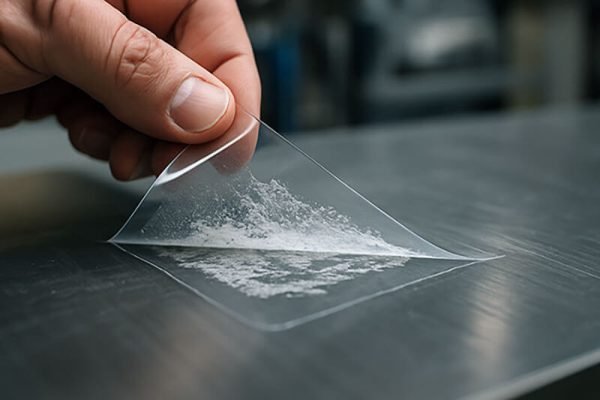
Common signs of incompatibility:
- Residue on the liner or substrate
- Poor peel or inconsistent force
- Voids, bubbles, or ghosting after curing
Compatibility by Adhesive Type
Different adhesives react differently to liner surfaces—and the mismatch isn’t always obvious.
Silicone PSA
- Requires low surface energy liners for clean release
- Platinum-cured silicones are sensitive to surface inhibition—standard silicone liners may interfere with curing
- In these cases, fluorosilicone liners offer higher inertness and more stable release force
Acrylic PSA
- Generally compatible with silicone liners
- Still at risk of anchoring or peel force drift, especially under heat or humidity
- Release level must be matched precisely to adhesive rheology
UV-Curable Adhesives
- Require UV-transmittable liners if cured through liner (e.g., PET or polyolefin)
- Surface must not interfere with photoinitiators
- Improper liners can cause under-cured edges or variable peel
How to Test for Compatibility
Testing early saves time, cost, and production risk down the line.
Don’t wait until production. Detect issues early with:
- Lab coating trials at target coat weight + cure conditions
- Peel force testing at various dwell times and temperatures
- Visual inspection for transfer, wrinkling, or inhibition zones
- Aging tests: re-test after 24h, thermal cycling, or humidity exposure
When to Use Fluorosilicone Liners
If your adhesive fails at the edge or leaves residue—it’s time to consider fluorosilicone.
| Scenario | Why Fluorosilicone Works |
|---|---|
| Platinum-cured silicone PSA | Prevents catalyst inhibition from liner surface |
| High-temp lamination or sterilization | Chemically stable at elevated temperatures |
| Skin-contact medical adhesives | High inertness, minimal extractables |
| UV-cured silicone-based gels | Avoids curing inhibition or residue |
| Ultra-low release force required | Stable RF over time and temperature |
Final Tips for Engineers, R&D, and Procurement
- Never assume liner compatibility across similar products
- Involve your liner supplier early during formulation trials
- Ask for technical data on surface treatment, release force range, and post-cure performance
- For sensitive or critical systems, always test the full stack: adhesive + liner + process
Ready to Validate Your Liner Compatibility?
We help coating and converting teams:
- Evaluate liner–adhesive pairing in real use conditions
- Select suitable fluorosilicone liners for demanding PSAs
- Reduce failure rates and optimize downstream efficiency